Fruit bushes that can bring new life to the garden – see the selection



Fruit bushes that can bring new life to the garden – see the selection
Fruit bushes are an easy and decorative way to add life, colour and flavour to the garden. They can be planted as hedges, in beds or in pots, and many varieties thrive well in the Danish climate. Whether you dream of sweet berries for desserts, fresh fruits for breakfast or simply wish to attract birds and butterflies, there are fruit bushes to suit every garden and taste.
In this article, you will get an overview of different types of fruit bushes and their characteristics, so you can find inspiration for which varieties can bring new life to your garden.
The article presents a wide selection of fruit bushes – from classic varieties such as redcurrant and blackcurrant to newer and more exotic ones. The aim is to provide an informative overview of the many possibilities, including differences in growth form, taste, care and use. The information about the products is based on descriptions from producers and retailers and is summarised to provide an easily accessible insight into the types of fruit bushes available on the market.
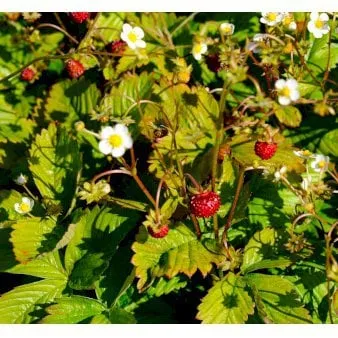
Wild strawberry (Fragaria vesca) is a perennial plant that grows low and forms dense clumps with runners that quickly spread and cover the ground. It thrives best in light to partial shade on moisture-retaining garden soil and requires only limited maintenance once established.
The plant grows to about 10–20 cm tall and has green, serrated leaves. In May–June, it blooms with small white flowers, which later develop into red, aromatic berries. Under favourable conditions, an additional flowering and fruiting may occur later in the summer.
Wild strawberry is suitable as ground cover in beds, under shrubs, or as a border plant in the kitchen garden. It is also a host plant for the butterfly Grizzled Skipper and thus contributes to biodiversity in the garden.
- Low-growing ground cover: Forms dense clumps and spreads with runners.
- Edible berries: Small, red, and aromatic fruits in the summer months.
- Flowering: White flowers in May–June, with the possibility of additional flowering later in the season.
- Placement: Thrives in sun to partial shade on moisture-retaining soil.
- Native species: Contributes to a natural and insect-friendly garden environment.
Pros and cons
- Easy to grow and undemanding plant
- Covers the ground effectively and suppresses weeds
- Produces edible berries
- Attracts pollinators and butterflies
- Can spread quickly and therefore requires some control in small beds
- The berries are small and ripen over an extended period
Pros and cons
Pros
- Easy to grow and undemanding plant
- Covers the ground effectively and suppresses weeds
- Produces edible berries
- Attracts pollinators and butterflies
Cons
- Can spread quickly and therefore requires some control in small beds
- The berries are small and ripen over an extended period
Pros
- Easy to grow and undemanding plant
- Covers the ground effectively and suppresses weeds
- Produces edible berries
- Attracts pollinators and butterflies
Cons
- Can spread quickly and therefore requires some control in small beds
- The berries are small and ripen over an extended period
Specifications
- Botanical name: Fragaria vesca
- Height: 10–20 cm
- Width: 20–40 cm
- Plant density: 7–9 plants per m²
- Plant spacing: approx. 30 cm
- Flowering period: May–June (possibly again later in the summer)
- Flower colour: White
- Fruit colour: Red
- Leaf colour: Green
- Growth form: Ground-covering, clump-forming with runners
- Placement: Sun / partial shade
- Growing conditions: Moisture-retaining garden soil
- Hardiness: Fully hardy
- Use: Ground cover, border plant, containers
- Ripening time: June–August
Læs også: